Palindromic-VC
How It Works
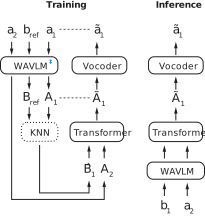
During pretraining, we use KNN over WavLM features to allign triplets of synthetic features - $\hat{B}_1\in\mathbb{R}^{1024\times{L}_1}$, real reference features - $A_2\in\mathbb{R}^{1024\times{L}_2}$, and real target wav segment - $a_1\in\mathbb{R}^{1\times{l}_1}$.
As a preliminary stage, we train a vocoder to reconstrcuct audio segments from WavLM features using a set of a reconstruction loss (MR-STFT, Yamamoto et al.) and adversarial losses (MPD, MSD; Kong et al.). We use this vocoder at the training stage to calculate losses at the waveform level.
Let $G$ denote the vocoder, $\tilde{a}_1=G(A_1)$, and $\mathcal{D}=\mathcal{D}_{\mathrm{MPD}}\cup\mathcal{D}_{\mathrm{MSD}}=\{D_k\}_{k=1}^{K}$ be the set of MPD and MSD sub-discriminators.
\[ \mathcal{L}_{\mathrm{voc}}^{G} = \lambda_{\mathrm{stft}}\mathcal{L}_{\mathrm{MR\text{-}STFT}}(a_1,\tilde{a}_1) +\lambda_{\mathrm{adv}}\mathcal{L}_{\mathrm{adv}}^{G}(G;\mathcal{D}), \] \[ \mathcal{L}_{\mathrm{MR\text{-}STFT}}(a,\tilde{a}) = \frac{1}{M}\sum_{m=1}^{M} \left( \mathcal{L}_{\mathrm{sc}}^{(m)}(a,\tilde{a}) +\mathcal{L}_{\mathrm{mag}}^{(m)}(a,\tilde{a}) \right), \] \[ \mathcal{L}_{\mathrm{sc}}^{(m)}(a,\tilde{a}) = \frac{ \sqrt{\sum_{t,f}\left(|S_m(a)_{t,f}|-|S_m(\tilde{a})_{t,f}|\right)^2} }{ \sqrt{\sum_{t,f}|S_m(a)_{t,f}|^2} }, \] \[ \mathcal{L}_{\mathrm{mag}}^{(m)}(a,\tilde{a}) = \frac{1}{T_mN_m} \sum_{t,f} \left| \log |S_m(a)_{t,f}|-\log |S_m(\tilde{a})_{t,f}| \right|. \] \[ \mathcal{L}_{\mathrm{adv}}^{G}(G;\mathcal{D}) = \sum_{k=1}^{K} \mathbb{E}_{A_1}\left[\left(D_k(G(A_1))-1\right)^2\right] = \sum_{k=1}^{K} \mathbb{E}_{\tilde{a}_1}\left[\left(D_k(\tilde{a}_1)-1\right)^2\right], \] \[ \mathcal{L}_{\mathrm{adv}}^{D}(\mathcal{D};G) = \sum_{k=1}^{K} \mathbb{E}_{(a_1,A_1)} \left[ \left(D_k(a_1)-1\right)^2 +D_k(G(A_1))^2 \right]. \]At the training stage, we train a transformer using a set of reconstruction losses at the features level (L1) and a speaker loss at the waveform level. The speaker loss utilizes a pretrained speaker verification model (Ecapa-tdnn, Desplanques et al.). We extract speaker embeddings and hiddent representations from both the ground-truth reference waveform $a_2$ and the converted waveform $\tilde{a}_1$, and compute the cosine similarity and L1 distance between them.
where $e(\cdot)$ is the ECAPA-TDNN speaker embedding and $h_\ell(\cdot)$ is the hidden representation extracted from layer $\ell$.
Finally, in order to improve the naturalness and reduce artifacts of the final synthesized speech, we train a vocoder on the convereted features. The vocoder is optimized using the same objectives as in the first stage.
Quantitative Results
Samples
Ablation Study
Stage 2: without vocoder post-training
Stage 3: with vocoder post-training